
1. Research Areas
Cell-Matrix Interaction
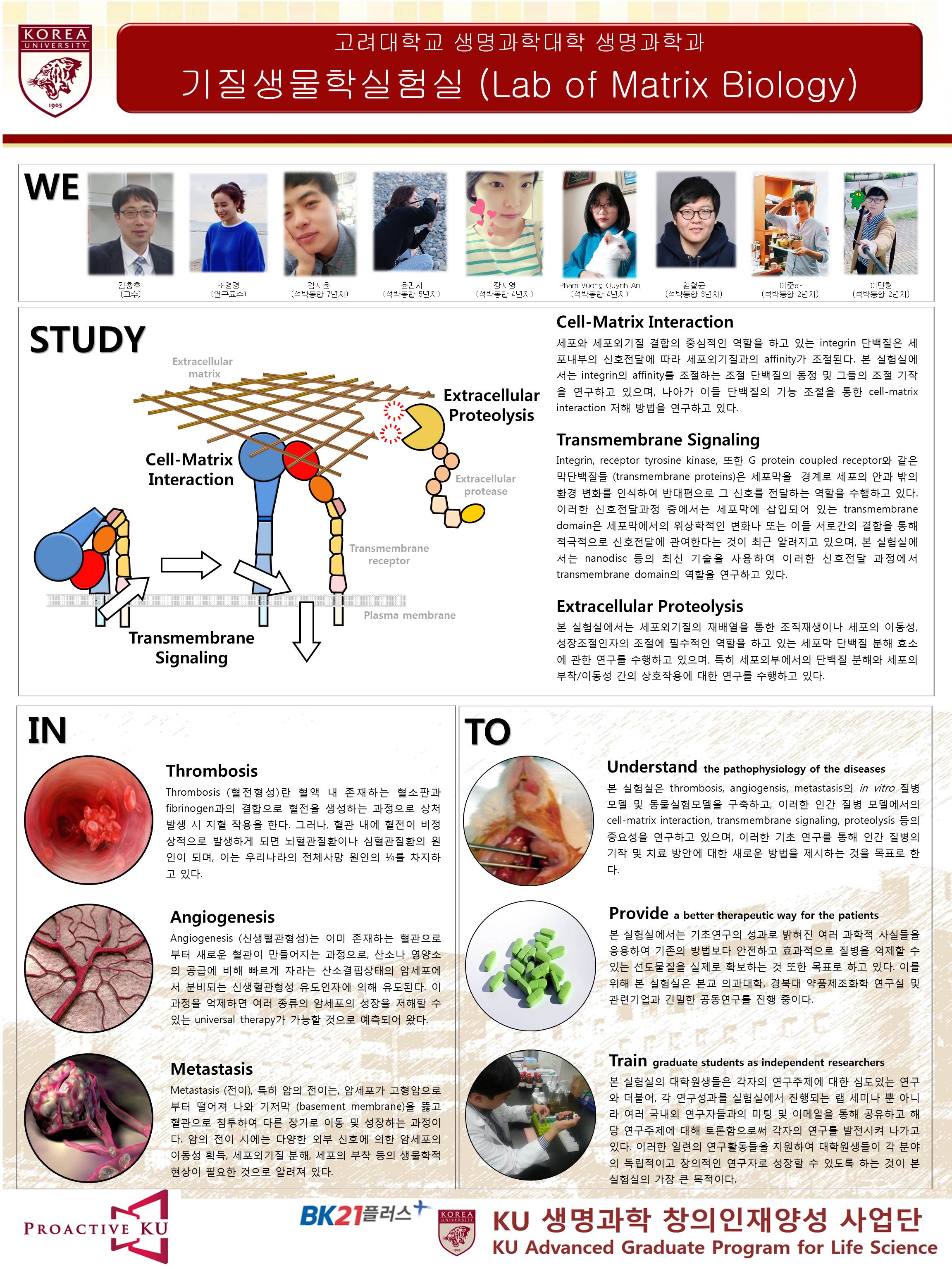
세포와 세포외기질 결합의 중심적인 역할을 하고 있는 integrin 단백질은 세포내부의 신호전달에 따라 세포외기질과의 affinity가 조절된다. 본 실험실에서는 integrin의 affinity를 조절하는 조절 단백질의 동정 및 그들의 조절 기작을 연구하고 있으며, 나아가 이들 단백질의 기능 조절을 통한 cell-matrix interaction 저해 방법을 연구하고 있다.
Integrins play a central role in cell-extracellular matrix (ECM) interactions, and their affinity for the ECM is modulated by intracellular signaling. Our laboratory focuses on identifying the regulatory proteins that control integrin affinity and elucidating their underlying mechanisms. Furthermore, we are exploring strategies to inhibit cell-matrix interactions by modulating the functions of these regulatory proteins.
Transmembrane Signaling
Integrin, receptor tyrosine kinase, 또한 G protein coupled receptor와 같은 막단백질들 (transmembrane proteins)은 세포막을 경계로 세포의 안과 밖의 환경 변화를 인식하여 반대편으로 그 신호를 전달하는 역할을 수행하고 있다. 이러한 신호전달과정 중에서는 세포막에 삽입되어 있는 transmembrane domain은 세포막에서의 위상학적인 변화나 또는 이들 서로간의 결합을 통해 적극적으로 신호전달에 관여한다는 것이 최근 알려지고 있으며, 본 실험실에서는 nanodisc 등의 최신 기술을 사용하여 이러한 신호전달 과정에서 transmembrane domain의 역할을 연구하고 있다.
Transmembrane proteins, such as integrins, receptor tyrosine kinases, and G protein-coupled receptors, function to sense environmental changes across the plasma membrane and transmit signals to the opposite side. Recently, it has become evident that the transmembrane domains embedded in the lipid bilayer actively participate in signal transduction through topological changes or intermolecular interactions. Our lab employs cutting-edge technologies like nanodiscs to investigate the precise roles of transmembrane domains in these signaling processes.
Extracellular Proteolysis
본 실험실에서는 세포외기질의 재배열을 통한 조직재생이나 세포의 이동성, 성장조절인자의 조절에 필수적인 역할을 하고 있는 세포막 단백질 분해 효소에 관한 연구를 수행하고 있으며, 특히 세포외부에서의 단백질 분해와 세포의 부착/이동성 간의 상호작용에 대한 연구를 수행하고 있다.
Our laboratory investigates cell surface proteases, which are essential for tissue regeneration through ECM remodeling, cell motility, and the regulation of growth factors. We particularly focus on the interplay between extracellular proteolysis and cell adhesion/migration.
2. Target Diseases & Pathological Models
Thrombosis
Thrombosis (혈전형성)란 혈액 내 존재하는 혈소판과 fibrinogen과의 결합으로 혈전을 생성하는 과정으로 상처 발생 시 지혈 작용을 한다. 그러나, 혈관 내에 혈전이 비정상적으로 발생하게 되면 뇌혈관질환이나 심혈관질환의 원인이 되며, 이는 우리나라의 전체사망 원인의 ¼를 차지하고 있다.
Thrombosis is the process of blood clot formation via the binding of platelets to fibrinogen, which serves to achieve hemostasis upon injury. However, abnormal thrombus formation within blood vessels leads to cerebrovascular or cardiovascular diseases, which account for one-fourth of all deaths in South Korea.
Angiogenesis
Angiogenesis (신생혈관형성)는 이미 존재하는 혈관으로부터 새로운 혈관이 만들어지는 과정으로, 산소나 영양소의 공급에 비해 빠르게 자라는 산소결핍상태의 암세포에서 분비되는 신생혈관형성 유도인자에 의해 유도된다. 이 과정을 억제하면 여러 종류의 암세포의 성장을 저해할 수 있는 universal therapy가 가능할 것으로 예측되어 왔다.
Angiogenesis is the formation of new blood vessels from pre-existing ones. It is often induced by angiogenic factors secreted from hypoxic cancer cells that rapidly outgrow their oxygen and nutrient supplies. Inhibiting this process has been anticipated to offer a universal therapy capable of hindering the growth of various types of cancer cells.
Metastasis
Metastasis (전이), 특히 암의 전이는, 암세포가 고형암으로 부터 떨어져 나와 기저막 (basement membrane)을 뚫고 혈관으로 침투하여 다른 장기로 이동 및 성장하는 과정이다. 암의 전이 시에는 다양한 외부 신호에 의한 암세포의 이동성 획득, 세포외기질 분해, 세포의 부착 등의 생물학적 현상이 필요한 것으로 알려져 있다.
Metastasis, specifically cancer metastasis, is the process by which cancer cells detach from a solid tumor, penetrate the basement membrane, enter the bloodstream, and subsequently migrate to and proliferate in other organs. It is well established that biological events such as the acquisition of cell motility, ECM degradation, and cell adhesion?triggered by diverse external signals?are requisite for cancer metastasis.
3. Research Objectives
Understand the pathophysiology of the diseases
본 실험실은 thrombosis, angiogensis, metastasis의 in vitro 질병 모델 및 동물실험모델을 구축하고, 이러한 인간 질병 모델에서의 cell-matrix interaction, transmembrane signaling, proteolysis 등의 중요성을 연구하고 있으며, 이러한 기초 연구를 통해 인간 질병의 기작 및 치료 방안에 대한 새로운 방법을 제시하는 것을 목표로 한다.
We establish in vitro and in vivo animal models for thrombosis, angiogenesis, and metastasis. By studying the significance of cell-matrix interactions, transmembrane signaling, and proteolysis within these human disease models, we aim to propose novel insights into the pathogenic mechanisms and develop new therapeutic strategies through our basic research.
Provide a better therapeutic way for the patients
본 실험실에서는 기초연구의 성과로 밝혀진 여러 과학적 사실들을 응용하여 기존의 방법보다 안전하고 효과적으로 질병을 억제할 수 있는 선도물질을 실제로 확보하는 것 또한 목표로 하고 있다. 이를 위해 본 실험실은 본교 의과대학, 경북대 약품제조화학 연구실 및 관련기업과 긴밀한 공동연구를 진행 중이다.
Applying the scientific findings obtained from our basic research, we also aim to secure actual lead compounds that can suppress these diseases more safely and effectively than conventional methods. To achieve this, our laboratory is conducting close collaborative research with the Korea University College of Medicine, the Medicinal Chemistry Laboratory at Kyungpook National University, and related biotechnology companies.
Train graduate students as independent researchers
본 실험실의 대학원생들은 각자의 연구주제에 대한 심도있는 연구와 더불어, 각 연구성과를 실험실에서 진행되는 랩 세미나 뿐 아니라 여러 국내외 연구자들과의 미팅 및 이메일을 통해 공유하고 해당 연구주제에 대해 토론함으로써 각자의 연구를 발전시켜 나가고 있다. 이러한 일련의 연구활동들을 지원하여 대학원생들이 각 분야의 독립적이고 창의적인 연구자로 성장할 수 있도록 하는 것이 본 실험실의 가장 큰 목적이다.
Graduate students in our lab not only pursue in-depth studies on their respective topics but also advance their research by sharing and discussing their findings. This takes place through lab seminars as well as meetings and email correspondence with various domestic and international researchers. Our ultimate goal is to support these research activities, empowering our graduate students to grow into independent, creative scientists in their fields.